What do we know currently?
According to an article in Scientific American, the World Health Organization’s Solidarity II is a study across more than a dozen countries which is examining antibody data from these populations. This is important to begin developing knowledge about the antibody response to COVID-19 and how nations can better protect their citizens. Researchers are currently trying to answer two questions: How long do COVID-19 antibodies remain in the blood? And whether or not they protect against reinfection. This will allow them to determine the types of vaccines they can produce and whether herd immunity is a viable option. Many scientists are studying other forms of Corona Viruses to find answers, because long-term data at this point is lacking. They are hoping that people make neutralizing antibodies, because vaccines would be much easier to develop if that was the case. Hopefully this data can be collected quickly so we can begin to combat this deadly virus sweeping the world.
How does the antibody response work?
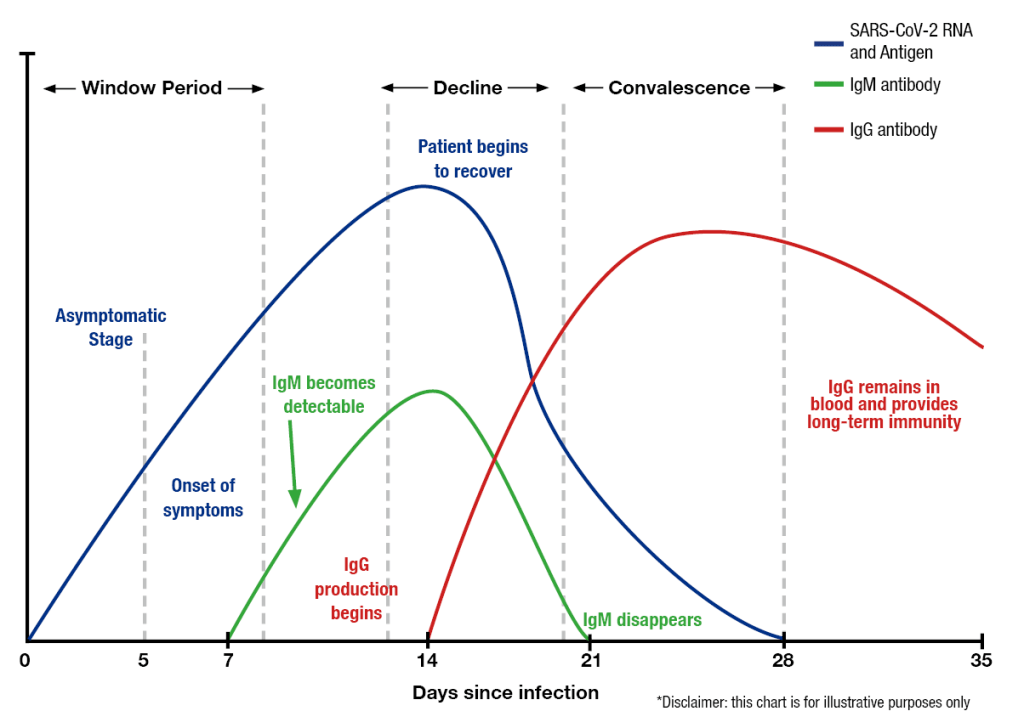
According to an article in Diazyme, the test for COVID-19 RNA genomes, or the test for a current COVID-19 infection, is currently producing many false negatives (some say as many as 1 in 3 patients tested). This obviously creates a dire need for IgM/IgG serological tests. IgM/IgG serological tests test for the presence of antibodies in the blood of patients, and provide a much more reliable way to to test for current and past infections. Unfortunately with COVID-19, the human antibody response to it is very slow therefore it may take up to 3 days after the onset of symptoms to be able to detect antibodies. If someone were to only have IgM titers, this would mean that the blood was taken from the patient during the primary or first infection from the virus, which is usually 7 days after infection with COVID-19. If the patient came back with both IgM and IgG titers, this would mean that the patient would be starting to recover from their primary infection, which occurs around 14-21 days after infection with COVID-19. Having primarily an IgG titer would mean that the patient has fully recovered from the initial infection. If we could determine who was IgG positive, this would mean that they were immune to reinfection and unable to infect others anymore.
What do I think?
I think that emerging research regarding the antibody response to COVID-19 gives much hope to the search for immunity and vaccinations against this virus. I also feel much more informed on testing after doing research for this blog. I now know that it requires a combination of IgM/IgG serological tests and Reverse Transcriptase tests to correctly diagnose COVID-19. I think this could possibly create a problem because the cost of testing is so high and having two tests as opposed to one raises prices even higher. I can’t imagine this pandemic getting any better until this important research has been done or a vaccination has been developed.

 Julia's Microbiology Blog